What happens when your audience grows unpredictably?
In many streaming projects, everything seems to work… until it stops working. And it usually doesn’t happen because of a single failure or a problem that was visible from the start. It happens when the audience stops behaving as expected. Because in live broadcasting, growth is not always gradual. Sometimes it is immediate. A major event, a decisive play, or a key moment can bring thousands of people into a stream at the same time. And that is where many platforms begin to show their limits.
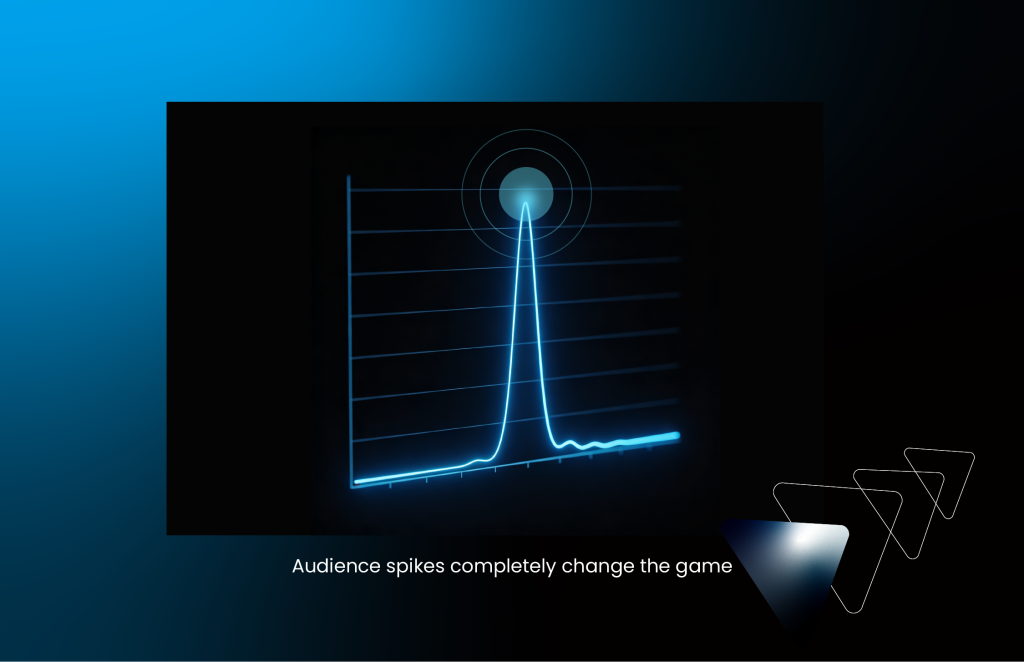
The problem isn’t the audience. It’s the spikes.
In streaming, having a large audience is not necessarily a problem.
The real challenge appears when that audience arrives all at once.
That is what happens in many live events, especially in sports:
- the match starts
- there is a key play
- a goal happens
- the content goes viral in seconds
And the infrastructure has to respond immediately.
Not minutes later.
This becomes especially visible in high-audience sporting events.
In a matter of seconds, a stream can go from stable load to receiving thousands of simultaneous connections.
And when that happens, any infrastructure limitation becomes immediately apparent.
What typically happens when the platform is not prepared
When a platform is not designed to handle these spikes, problems appear quickly:
- buffering
- interruptions
- increased latency
- quality degradation
- partial or complete outages
And most importantly:
the poor experience happens precisely at the moment of highest audience.
In other words, when the business impact is also the greatest.
The most common mistake: designing for the average
Many times, platforms are designed based on “normal” user behavior.
But live streaming rarely works that way.
The audience does not always grow in a stable and predictable manner.
In certain events, traffic behaves in spikes.
And if the architecture is not prepared to absorb these sudden changes, any moment of high concurrency becomes a risk.
In sports, this is even more evident
In the sports world, these scenarios are constant.
The audience changes within seconds.
In addition, in markets like Mexico and other Latin American countries, live content consumption continues to grow rapidly, especially around sporting events.
That means more and more teams need to think not only about broadcasting content, but also about how to sustain the experience when thousands of users arrive at the same time.
Because when a stream fails during a key moment, the problem is no longer technical.
It is a matter of trust.

Preparing for the worst moment
Teams that have already gone through these kinds of situations often completely change the way they design their platforms.
Instead of thinking about average traffic, they prepare their infrastructure for the worst-case scenario:
- concurrency spikes
- sudden growth
- mass events
- maximum simultaneous demand
Because in streaming, the most important moment never gives warning.
Conclusion
In streaming, the most critical problems almost never appear under normal conditions.
They appear during moments of peak audience.
And in live events, especially in sports, those moments arrive quickly, without warning, and with thousands of users connecting at the same time.
That is why designing a platform based solely on average usage is no longer enough.
The real test lies in the ability to respond when all the traffic arrives at once.
Because in the end, a broadcast is not remembered when everything went well.
It is remembered when it failed at the most important moment.
CEO Flumotion
Let's design your streaming architecture
We analyze your situation and determine the optimal combination of products based on your technical and business needs.