How to Choose the Right Architecture for a Professional Streaming Project by:
COO Flumotion
How to choose the right architecture for a professional streaming project
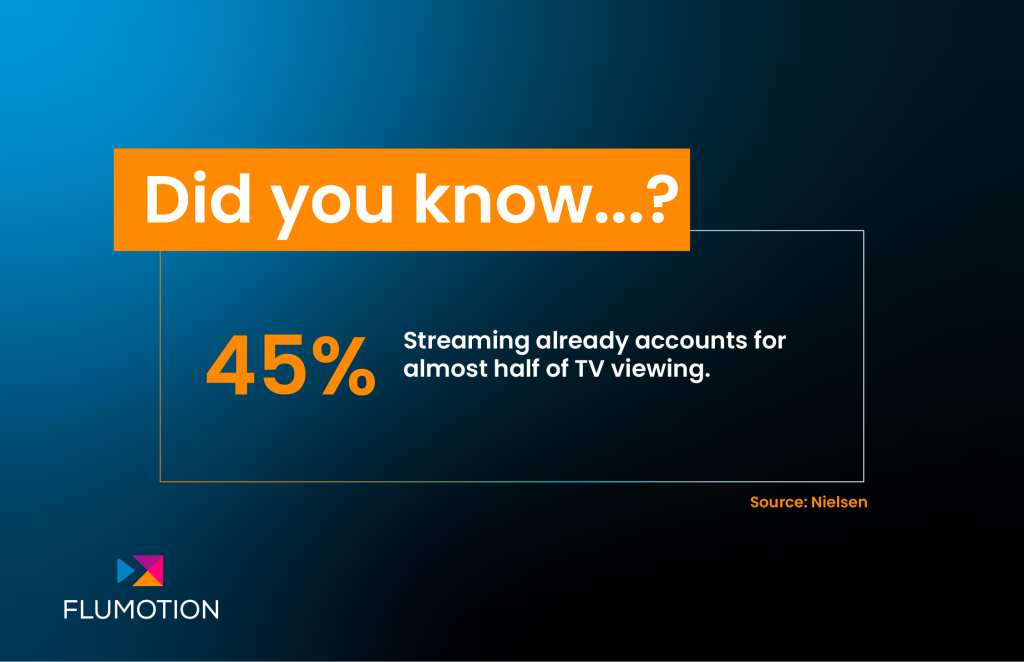
The figure is interesting because it puts things into perspective: streaming is no longer simply a complementary channel. Behind every platform, broadcast, or digital experience, there is an infrastructure that must be able to respond to the specific needs of its audience.
And that is where the real challenge begins.
There is no one-size-fits-all streaming architecture
When designing a streaming project, it is easy to start with the technology: which protocol to use, which CDN to choose, which player to integrate, or what infrastructure is needed to process the content.
But those decisions should come later.
Before talking about specific technologies, there is a more important question:
What does the project really need?
An OTT platform with thousands of hours of on-demand content does not have the same needs as a live sports broadcast. A corporate event presents different challenges from an online radio station, and a platform expecting to expand internationally will need to make different decisions from a service targeting a local audience.
In all these cases, we are talking about streaming, but the architecture behind them can be completely different.
That is why designing a professional streaming architecture is not about bringing together as many technologies as possible. It is about understanding what each project needs and building from those requirements.
In this article, we review the main factors that should be taken into account before making these decisions.
What is the architecture of a streaming project?
We can understand streaming architecture as the set of components and processes that make it possible to take content from its source to the end user, while also managing everything that happens around that content.
Although each project may have a different configuration, a streaming workflow can include elements such as:
Ingest → Processing & Transcoding → Packaging → Management → Distribution → Player → User
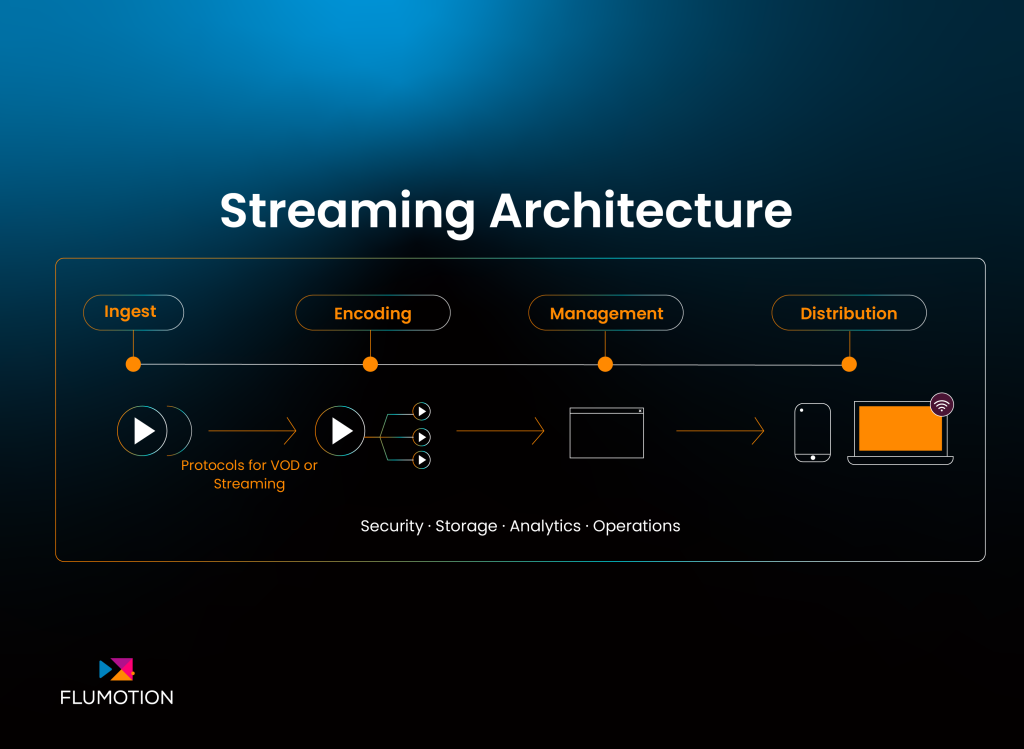
Each of these components solves a specific problem.
And that is precisely the point: not every project needs to solve the same problems.
A professional architecture must find the right balance between performance, availability, quality, security, scalability, and operational complexity, according to the specific objectives of the service.
What factors define the perfect architecture?
There is no single answer for every project. Before choosing technologies or providers, it is worth analysing a series of variables that will determine how the architecture should be built.
What type of content will be distributed?
[…]
Who will consume it and at what scale?
[…]
What level of latency is required?
[…]
Conventional Streaming
30 - 45s
Conventional experience
For content where a few seconds of delay do not significantly affect the experience. Content latency will not necessarily be a critical factor.
Low-Latency HLS
3 - 5s
Balance between latency, compatibility, and scalability
For experiences where reducing delay is important while maintaining a balance between compatibility and distribution.
Under a second latency
>1s
Near real-time interaction
For experiences where immediacy is essential: interactive events, betting, live shopping, remote production, etc.
What level of quality and availability is required?
[…]
What level of security does the content need?
[…]
Where and how will it be distributed?
[…]
What happens after the broadcast?
[…]
How will it be measured and optimised?
[…]
How will it be operated and evolved?
Build, integrate, or use an existing solution?
Once the project requirements have been defined, another important decision emerges: which parts of the architecture should we build ourselves, and which can be solved by integrating existing technologies or services?
There is no single answer.
In some projects, developing proprietary components may make sense because they address a business need that differentiates the company. In others, using specialised solutions can reduce implementation times and allow the team to focus its resources on what actually creates value.
The decision should take into account:
- Which functionalities are truly differentiating.
- Which components already exist and are sufficiently mature.
- What level of customisation is required.
- What capacity the team has to operate and maintain the solution.
- What dependencies are being introduced.
- How the decision will affect future growth.
There would be little point in developing every component of a platform from scratch if specialised technologies already exist that can reliably solve specific parts of the architecture.
But neither is it advisable to turn the project into a collection of independent services without an overall vision.
The goal should not be to build everything or outsource everything. It should be to decide what is worth controlling, what is better integrated, and how to make all the pieces work together as a coherent system.
Different projects, different architectures
One of the most important ideas when designing a streaming platform is that two projects that apparently do the same thing may require very different architectures.
Let’s consider some scenarios:
📺 A VOD Platform
Its priorities may include:
- Storage
- Catalogue management
- Multiple quality profiles
- Content protection
- On-demand distribution
- Consumption analytics
Content latency will not necessarily be a critical factor.
⚽ A live sports event
Here, the priorities change.
The architecture may require:
- Redundant ingest
- Real-time transcoding
- Low latency
- Capacity for large concurrency peaks
- Robust distribution
- Monitoring
- Failover mechanisms
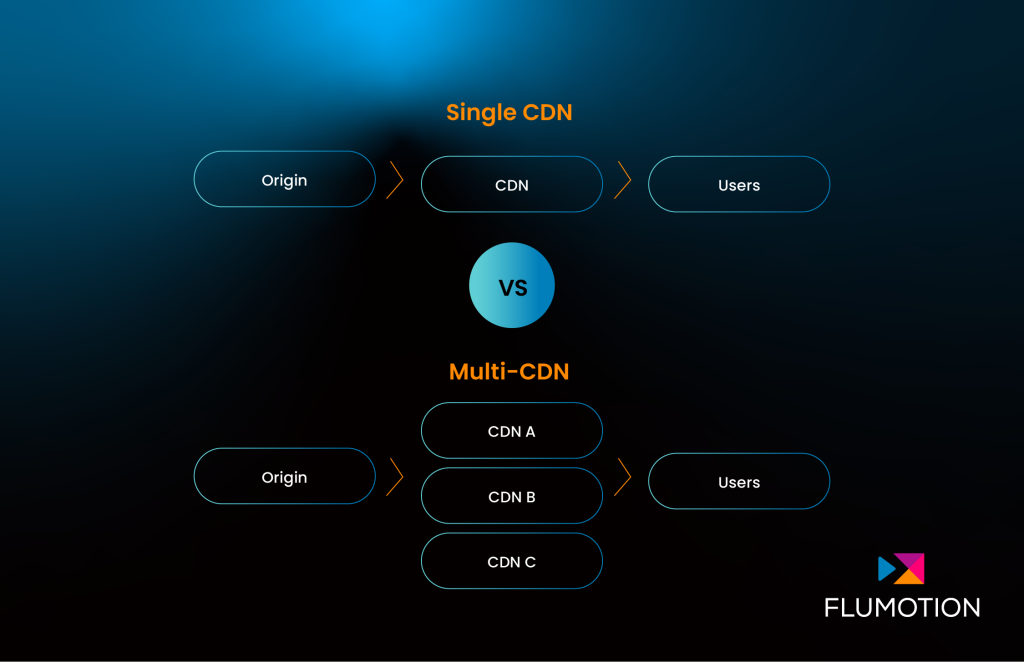
And if the event is also international, a Multi-CDN strategy may need to be considered.
🎓 An Interactive Learning Platform
It may have different requirements:
- Low latency
- Interaction between users and speakers
- Integration with external tools
- Authenticated access
- Session recording
- Subsequent on-demand availability
📻 A radio platform
The architecture may be more focused on:
- Broadcast continuity
- Stable ingest
- Audio distribution
- Availability
- Automation
- Content management
These examples show something important:
Architecture should not be determined by the technology available, but by the needs of the service we want to build.
Common mistakes when designing a streaming architecture
1. Starting with the technology
[…]
2. Designing only for the present
[…]
3. Adding complexity because it “sounds better”
[…]
What specific problem are we solving with it?
4. Thinking only about the broadcast
[…]
5. Failing to consider operations
[…]
A solution that cannot be operated efficiently is not truly a sustainable solution.
How to choose the right architecture: A practical framework
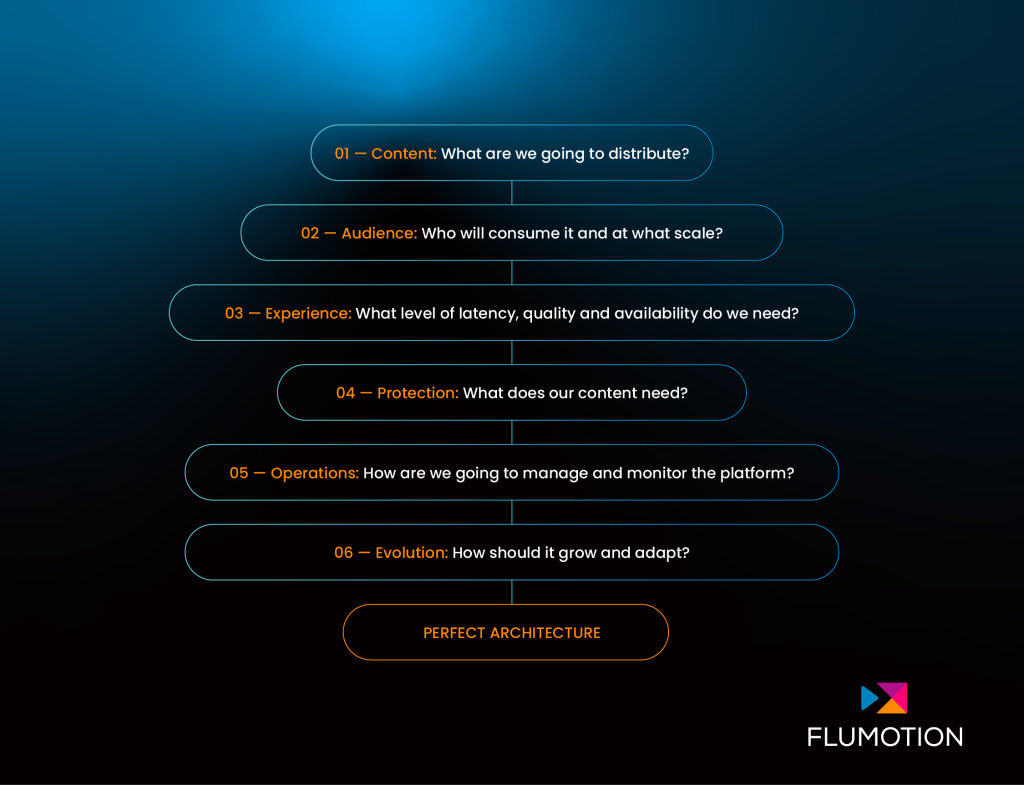
1. What are we going to distribute?
Live, VOD, radio, events, premium content, user-generated content…
2. Who will consume it?
Number of users, concurrency, devices, markets, and geographical distribution.
3. What experience do we need to deliver?
Quality, latency, interaction, availability, and service continuity.
4. What does our content need?
Security, DRM, storage, editing, reuse, and subsequent distribution.
5. How are we going to operate the platform?
Monitoring, support, automation, maintenance, and responsiveness to incidents.
6. How should it evolve?
Audience growth, new markets, new devices, new business models, and integration of new technologies.
The answers to these six questions should allow us to build a requirements map.
And only then does it make sense to start defining the specific components of the architecture.
An Architecture Designed to Evolve
In professional streaming projects, the architecture rarely remains exactly the same throughout the entire lifetime of the service.
The audience may grow. New markets may emerge. The devices used to consume content may change. New monetisation models may be introduced, or new interaction and personalisation needs may arise.
That is why a good architecture should not only aim to solve the current problem.
It should provide a foundation on which the project can evolve.
This does not mean anticipating every possible future need or building infrastructure that we do not need yet.
It means making decisions that allow changes to be incorporated without compromising system stability.
In this sense, flexibility is also a characteristic of the architecture.
Conclusion
Choosing a streaming architecture is not about finding a universal combination of technologies.
It is about understanding the project, identifying its needs, and establishing priorities.
Content, audience, latency, quality, security, distribution, operations, and evolution are some of the variables that will determine which architecture makes sense in each case.
That is why two streaming projects that appear similar may require completely different solutions.
Technology is a fundamental part of the equation, but architecture should serve the project, not the other way around.
At Flumotion, we start precisely from this idea: analysing the specific needs of each project to design streaming architectures that can respond to their current requirements and evolve with them. This philosophy aligns with the positioning we are building around customised architectures, scalability, and flexible integration.
COO Flumotion
Let's Design Your Streaming Architecture
Let’s talk about which architecture could make sense for your project.